What anxiety is
MedlinePlus describes anxiety as a feeling of fear, dread and uneasiness. It can be a normal reaction to stress, and it may even help you focus. In an anxiety disorder, the fear does not go away and can be overwhelming.
- Generalized anxiety disorder: frequent worry or tension about ordinary things such as health, money, work and family, on most days for at least 6 months, and hard to control.
- Panic disorder: sudden, repeated periods of intense fear when there is no danger.
- Phobias: an intense fear of something that poses little or no actual danger, such as social situations.
Anxiety shows up in the body as well as the mind: a pounding or rapid heartbeat, dizziness, shortness of breath, muscle tension, an upset stomach, sweating, tiredness, irritability, trouble concentrating and poor sleep. The cause is unknown; genes, brain chemistry, stress and environment may all play a part.
The Anxiety page is the reference; this post explains the routine and the evidence behind it. Related pages: Panic Attack, Insomnia and Low Mood and Depression.
Get help first
Thoughts of self-harm: if you have thoughts of hurting yourself or of suicide, get help right away: call your local emergency number. In the United States, you can also call or text 988, the Suicide & Crisis Lifeline, at any hour.
Anxiety or the heart? MedlinePlus notes that a panic attack may be mistaken for a heart attack. Don't assume it is anxiety. Call your local emergency number right away for chest pain or discomfort that lasts more than a few minutes or feels like pressure, squeezing or fullness; pain in the jaw, neck, back, arms or shoulders; shortness of breath; or feeling weak, light-headed or faint, perhaps with a cold sweat. These are the heart attack signs the CDC lists.
See a provider if you often worry or feel anxious, especially when it gets in the way of daily life, or if panic attacks interfere with your work, your relationships or your self-esteem. The main treatments for anxiety disorders are talk therapy, such as cognitive behavioral therapy, medicines, or both; MedlinePlus says most people with generalized anxiety disorder improve with them. If you take a daily medicine for anxiety, don't stop it without talking to your provider. See also when not to self-treat.
What research says
We found no Cochrane review of acupressure or acupuncture for anxiety or anxiety disorders, so little high-quality research exists. MedlinePlus names talk therapy and medicines as the main treatments, with support groups and stress management as possible help alongside them. So the points below are tradition, labelled as such: a calm practice to use alongside care, not in place of it.
The points
Traditional use: in TCM, points such as HT-7, PC-6 and KI-3 are traditionally used for anxiety and restlessness. Each point's page shows where to find it and when to skip it.
- Main points: HT-7 Spirit Gate (Shén mén) at the wrist crease, PC-6 Inner Pass (Nèi guān) on the inner forearm, and KI-3 Supreme Stream (Tài xī) at the inner ankle.
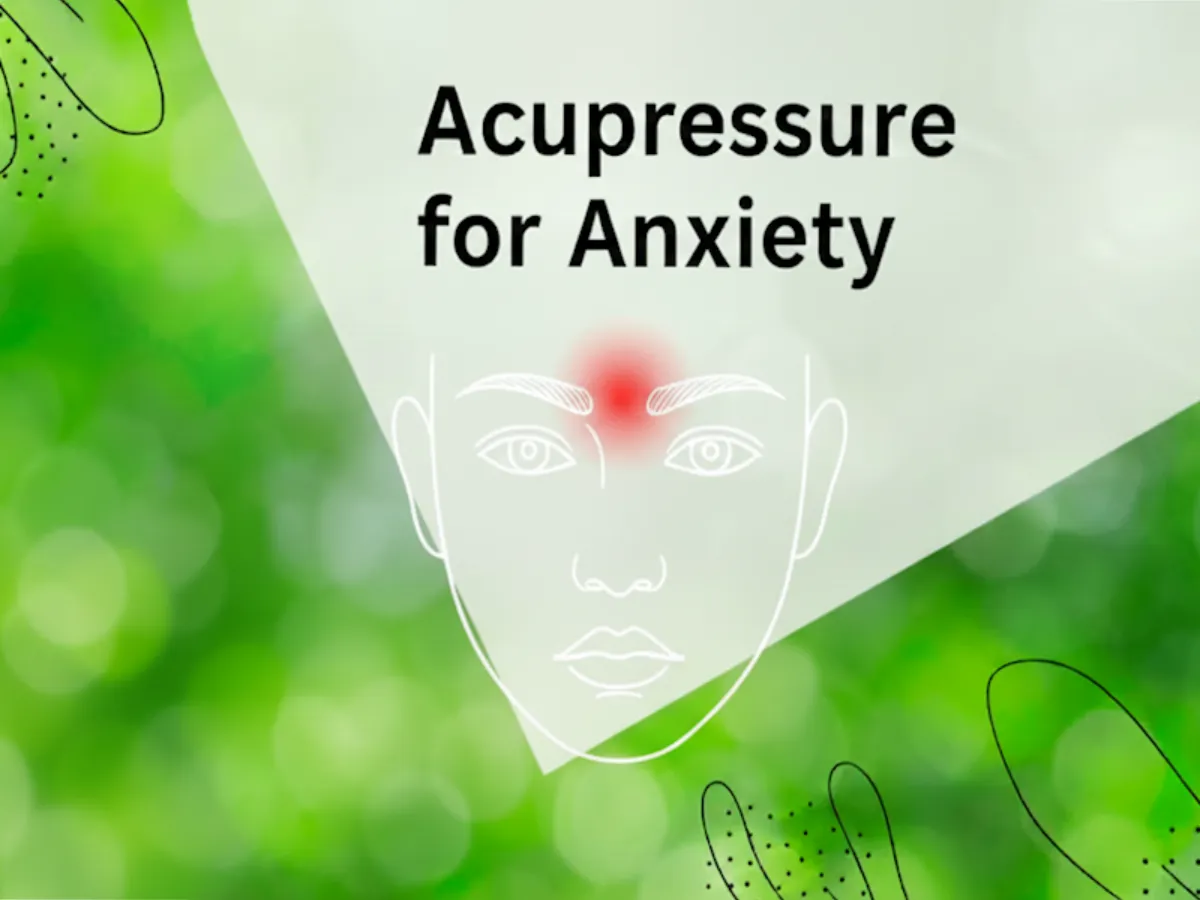
- For racing thoughts: EXT-2 Hall of Impression (Yìn táng) between the eyebrows.
- For physical tension: LR-3 Great Rushing (Tài chōng) on the top of the foot.
- Optional: SP-6 Three Yin Intersection (Sān yīn jiāo) on the inner lower leg.
How to press
The Anxiety routine takes 10 to 15 minutes. The idea behind it: anxiety is felt in the body, in a racing heart, fast breathing and tight muscles, so the routine does not start with the points. It starts by bringing your attention to what is around you and slowing your breath, and only then moves to gentle pressure on points you can reach sitting down, on the wrists and feet.
- Find a quiet place where you won't be interrupted.
- Ground yourself: name 5 things you can see, 4 you can touch, 3 you can hear, 2 you can smell and 1 you can taste.
- Breathe slowly: in for 4 counts, hold for 2, out for 8, five to ten times.
- Massage HT-7 gently in slow circles for 2 minutes on each hand.
- Press PC-6 with steady pressure for 1 to 2 minutes on each arm, firm but never painful.
- Press KI-3 for 1 to 2 minutes at each ankle, beside the bone rather than on it.
- For racing thoughts, add EXT-2 with gentle pressure for 1 to 2 minutes.
- For physical tension, add LR-3, pressing beside the pulse rather than hard on it.
- Optional: add SP-6, pressing into the soft tissue beside the shin bone.
- End with 5 minutes of slow breathing, or let each part of the body go loose from the toes to the head.
If you are new to it, hold each point for 15 to 30 seconds and work up to the times above. Pressure should never be painful.
Pregnancy: SP-6 is not pressed during pregnancy. Ask a trained professional instead.
Skip or ease off: HT-7 can stir up strong feelings or memories, its page notes, so keep it gentle, stop if it upsets you, and go especially lightly if you are very low or depressed. PC-6 after a wrist injury or surgery, and ease off if your fingers tingle. KI-3 after ankle surgery or with a fresh sprain. EXT-2 with a nosebleed, a broken nose or an injury to the face. LR-3 after foot surgery or if you have very low blood pressure. SP-6 after leg surgery. Don't press on broken, irritated or blistered skin, bruises or new scars. If you have a bleeding or clotting disorder or low platelets, press more lightly and for less time, or ask your doctor first.
Habits that help
MedlinePlus lists these self-care steps for generalized anxiety disorder:
- cut down on caffeine;
- don't use street drugs or drink heavily;
- exercise, get enough rest and eat healthy foods;
- keep a regular routine, and leave the house every day.
Caffeine, other substances and some medicines can make anxiety worse, and for panic attacks MedlinePlus adds that some cold medicines and other stimulants can trigger them. If you take any medicines, ask your provider whether they may play a part. A support group can make you feel less alone, but it is not a substitute for talk therapy or medicine.