Why hair falls out
Some hair loss is normal. MedlinePlus notes that the scalp holds about 100,000 hairs and that you lose roughly 50 to 200 of them every day. In most people, those hairs grow back. Hair loss usually develops gradually, and it may be patchy or all over the scalp.
The most common kind comes with age. Both men and women tend to lose hair thickness and amount as they get older, linked to heredity and changes in the hormone testosterone rather than to a disease. Pattern baldness affects many more men than women: about 80% of men show signs of it during their lifetime.
A second kind follows stress. Physical or emotional stress can make one half to three quarters of the scalp hair shed, a type of hair loss called telogen effluvium. Hair comes out in handfuls when you shampoo, comb or run your hands through it. It often starts weeks to months after the stressful event, so the link is easy to miss. MedlinePlus lists these triggers:
- high fever or severe infection;
- childbirth;
- major surgery, major illness or sudden blood loss;
- severe emotional stress;
- crash diets, especially ones without enough protein;
- some medicines, including retinoids, birth control pills, beta-blockers, calcium channel blockers, certain antidepressants and NSAIDs such as ibuprofen.
The shedding eases over 6 to 8 months and is usually temporary, though it can become long-term. Other causes include alopecia areata (bald patches), anemia, thyroid disease, lupus, diabetes, hormone changes, ringworm or bacterial infections of the scalp, radiation therapy, hairstyles that pull hard on the hair, a lot of shampooing and blow-drying, and nervous habits such as constant hair pulling or scalp rubbing. The Hair Loss page is the reference; this post explains the routine behind it.
When to see a provider
MedlinePlus notes that what helps depends on the cause, and that sometimes dealing with the cause is enough. It advises contacting your health care provider if:
- you are losing hair in an unusual pattern;
- you are losing hair fast, or at an early age, such as in your teens or twenties;
- the hair loss comes with pain or itching;
- the skin under the area is red, scaly or otherwise abnormal, or there are areas of infection on your scalp;
- you also have acne, facial hair or an abnormal menstrual cycle;
- you are a woman with male-pattern baldness;
- you have bald spots in your beard or eyebrows;
- you also have weight gain, muscle weakness, trouble tolerating cold, or fatigue.
A careful history and a look at the hair and scalp are usually enough to find the cause; blood tests or a scalp biopsy are rarely needed. A provider can then suggest medicines, a supplement if a vitamin is low, or hair restoration. If you think a medicine is behind your hair loss, talk to the provider who prescribed it before changing anything. See also when not to self-treat.
What research says
Little high-quality research exists for acupressure and hair loss. The closest evidence is on acupuncture and on scalp massage.
A 2026 systematic review (Jun and colleagues, Korea Institute of Oriental Medicine) looked at acupuncture for alopecia areata. It found 11 randomized trials with 1,144 people, searched up to December 2024. Most trials had an unclear risk of bias. In 7 of them, plum-blossom needling (tapping the skin with a cluster of fine needles) added to standard medical care improved symptoms in slightly more people than medical care alone. The authors rated the evidence low certainty and called for larger, more rigorous studies. None of the trials tested acupressure.
A small 2016 study in Japan (Koyama and colleagues, funded in part by a hair-care company) gave 9 healthy men with no obvious hair loss 4 minutes of scalp massage a day for 24 weeks, with a massage device, on one side of the scalp, and compared it with the other side. Hairs got slightly thicker on the massaged side. The number of hairs did not go up: it dipped at 12 weeks and was no different from the other side by the end.
So little high-quality research exists for acupressure and hair loss, and the points below are tradition, labelled as such: a calm 15 minutes alongside finding the cause, not a way to grow hair back.
The points
Traditional use: in TCM, points such as GV-20, KI-3 and SP-6 are traditionally used for hair loss. Each point's page shows where to find it and when to skip it.
- Main points: GV-20 Hundred Meetings (Bǎi huì) at the top of the head, KI-3 Supreme Stream (Tài xī) at the inner ankle, and SP-6 Three Yin Intersection (Sān yīn jiāo) on the lower leg.
- For hair loss that follows stress: LR-3 Great Rushing (Tài chōng) on the top of the foot.
- Optional: BL-17 Diaphragm Shu (Gé shū) on the middle back and BL-23 Kidney Shu (Shèn shū) on the lower back.
How to press
The Hair Loss routine takes about 15 minutes, 3 to 5 times a week. The idea behind it: stress is one of the causes MedlinePlus names, so the routine opens and closes slowly. The scalp massage at the end is gentle and lasts a few minutes, because constant scalp rubbing is itself on the list of causes. If you are shedding, some hair may come away on your fingers: MedlinePlus notes that with stress-related shedding, hair comes out when you run your hands through it.
- Sit comfortably with your shoulders relaxed and your back straight.
- Breathe slowly and deeply for 5 minutes.
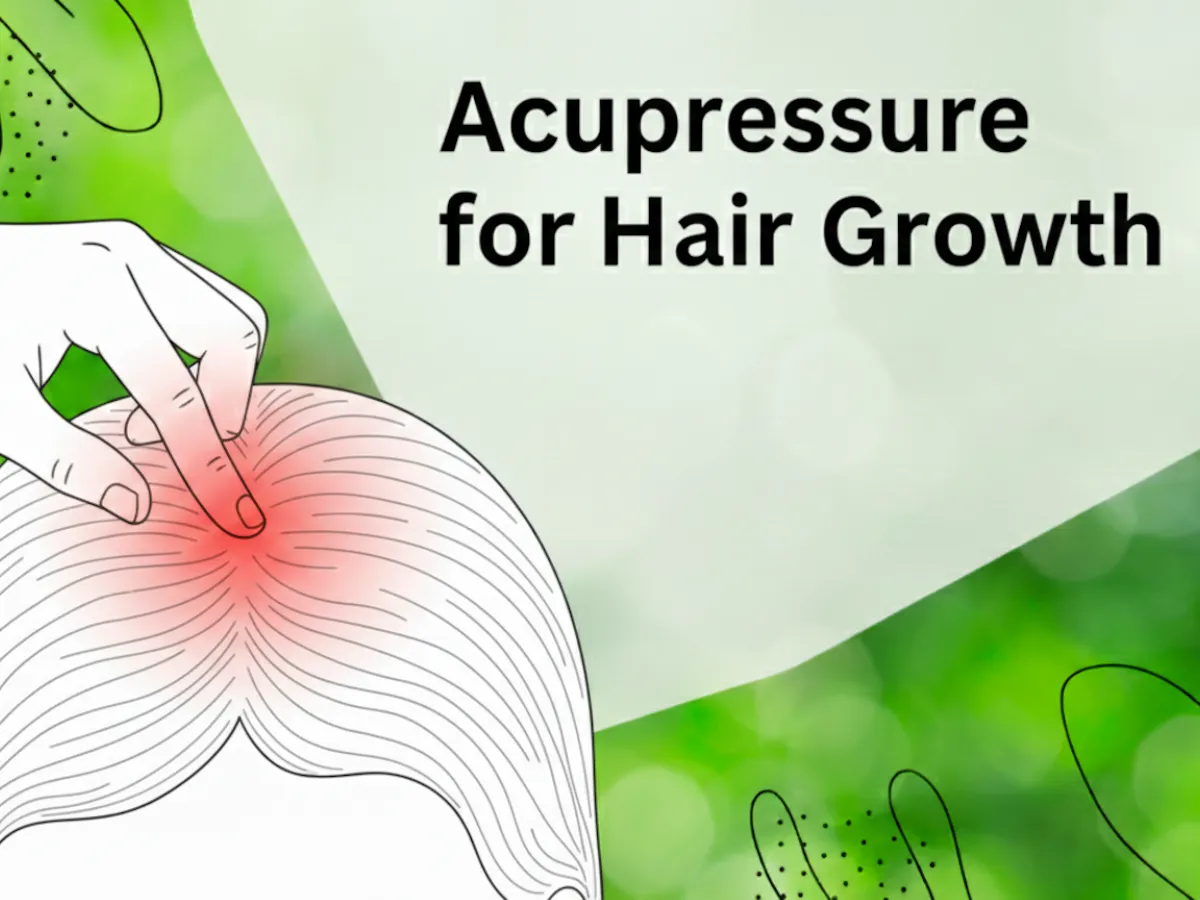
- Press GV-20 gently, 1 to 2 minutes.
- Press KI-3, 1 minute on each foot.
- Press SP-6, 1 minute on each leg.
- For hair loss that follows stress: add LR-3, 1 minute on each foot.
- Optional: BL-17 and BL-23.
- Finish with 5 minutes of gentle scalp massage with your fingertips, in small circles from the hairline to the crown, without pulling the hair.
Pressure should be firm enough to feel but never painful, and never deep or unrelenting.
Skip or ease off: don't press or massage scalp skin that is red, scaly, broken, blistered or infected; have it checked instead. Don't press on bruises or new scars. Don't press SP-6 during pregnancy. GV-20: light pressure only, stop if you feel dizzy, and skip it after a head injury or with very high blood pressure. KI-3 after ankle surgery or with a fresh sprain or injury. SP-6 after leg surgery. LR-3 after foot surgery or with very low blood pressure. BL-23 over a recent back injury or surgery site. If you have a bleeding or clotting disorder or low platelets, check with your doctor before pressing BL-17, and press every point more lightly and for less time.
Day to day
From MedlinePlus:
- give it time: hair lost after an illness such as a fever, radiation therapy or a medicine usually grows back once the illness ends or the therapy is finished, and hair loss after childbirth or menopause often goes away within 6 months to 2 years;
- cover up meanwhile if you like: a wig, hat, hair weave, hair piece or a new style is generally the least expensive and safest approach, but a hair piece should never be sewn to the scalp, because of the risk of scars and infection;
- go easy on your hair: tight hairstyles, a lot of shampooing and blow-drying are all on the list of causes;
- eat enough protein: crash diets without it can trigger shedding.
If shedding goes on, or any sign from the list above shows up, see your provider rather than waiting it out.