Most low back pain is a strain, and it passes
MedlinePlus says sudden low back pain most often comes from an injury to the muscles and ligaments that support the back: a strain, a tear or a spasm, often after lifting something heavy, moving suddenly or sitting in one position for a long time. It lasts from a few days to a few weeks. Many people feel better within a week, and most recover within 4 to 6 weeks.
Less often the cause is somewhere else: a disc, a fracture, the nerves, or an organ outside the spine such as the kidneys. That is why the warning signs below matter more than any point.
The Lower Back Pain page is the reference; this post explains the routine and the evidence behind it.
What research says
We found no Cochrane review of acupressure for back pain. The closest is a 2020 Cochrane review of needle acupuncture for chronic nonspecific low back pain: pain with no clear cause that lasts more than three months. It pooled 33 studies with 8,270 people.
- Against sham acupuncture: pain was a little lower right after the sessions, but the difference was below what counts as clinically important, and the evidence is low certainty. Back function was no better.
- Against no acupuncture: pain and function were better right after the sessions, with moderate-certainty evidence.
So the research is about needles, about long-lasting pain, and about the short term. It does not show what pressing points at home does for a fresh back strain; the points below are tradition, labelled as such.
The points
Traditional use: in TCM, points such as BL-23, BL-25 and GV-3 are traditionally used for low back pain. Each point's page shows where to find it and when to skip it.
- Main points: BL-23 Kidney Shu (Shèn shū) and BL-25 Large Intestine Shu (Dà cháng shū) on the muscles beside the spine, and GV-3 Yang Pass (Yāo yáng guān) on the midline of the lower back.
- For pain that spreads down the leg: BL-40 Middle of the Crook (Wěi zhōng) behind the knee, or KI-3 Supreme Stream (Tài xī) at the inner ankle.
- Also used: GV-4 Life Gate (Mìng mén), on the midline above GV-3.
How to press
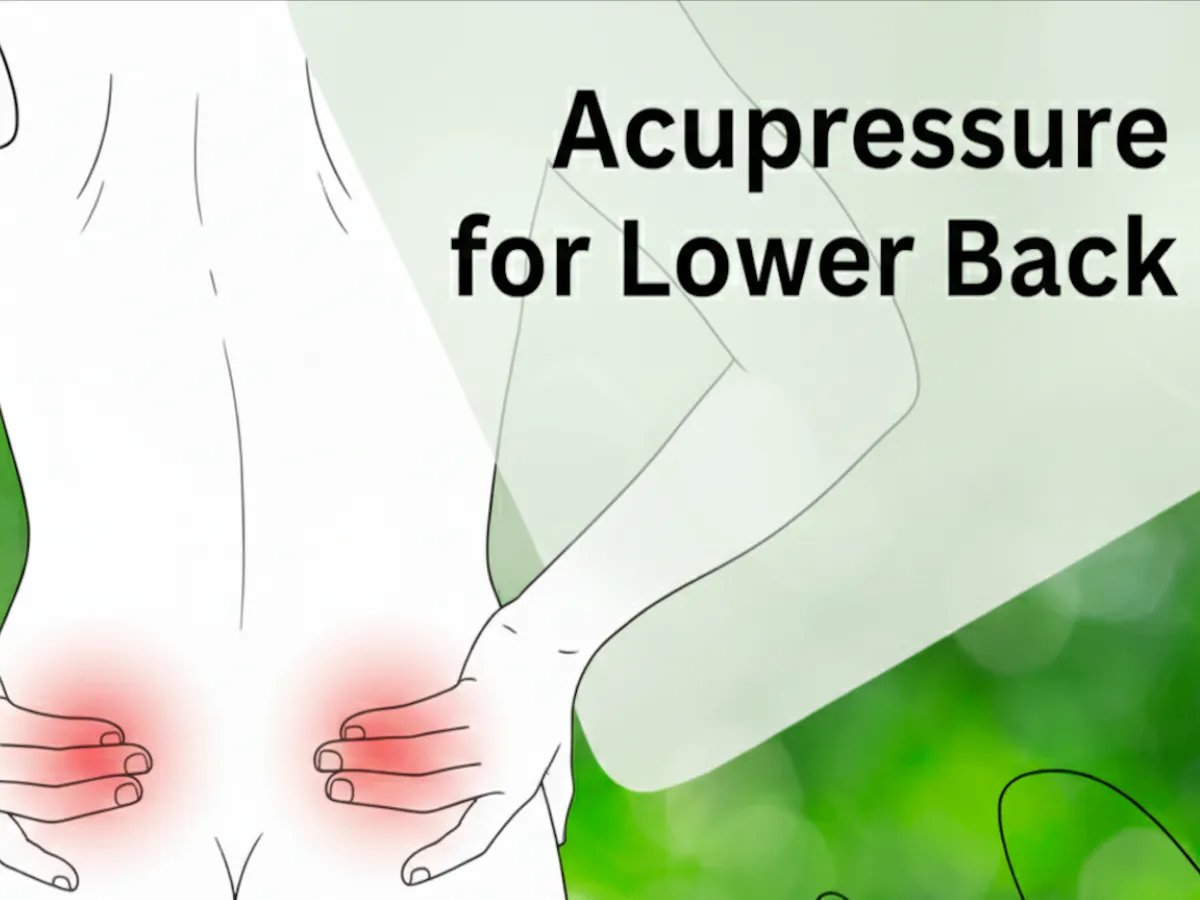
The Lower Back routine has the order and timings. Two ideas sit behind it. The main points are on your own back, where twisting to reach them strains the very muscles that hurt, so the routine has someone else press them while you lie flat or sit supported. And the leg points are there for the days you are on your own: BL-40 and KI-3 are easy to reach sitting down.
- Lie flat on a firm surface, or sit with good back support.
- Your helper presses BL-23 on both sides for 2 minutes, leaning in on the muscle, not the bone, firm but never painful.
- Then BL-25 on both sides for 1 minute.
- Then GV-3 for 1 minute, with gentle fingertip contact, never deep.
- If the pain spreads down the leg, add BL-40 or KI-3. Press BL-40 lightly with the knee slightly bent: large blood vessels run behind the knee.
If you cannot reach a back point comfortably, skip it rather than strain. Hold each point for 15 to 30 seconds to begin with, and work up to 1 to 2 minutes. Do both sides for points that come in pairs.
Skip: BL-23 over a recent back injury or surgery site; GV-3 with a spinal fracture or a severe disc herniation, and stop if leg numbness or pain develops; GV-4 during a fever or with high blood pressure; BL-40 with a bleeding disorder; KI-3 after ankle surgery or with a fresh sprain. Don't press on broken, irritated or blistered skin, bruises or new scars. If you have a bleeding or clotting disorder or low platelets, press more lightly and for less time, or ask your doctor first.
Self-care alongside
MedlinePlus suggests:
- cutting back on normal activity for the first couple of days, then slowly returning to it. Bed rest is not advised: staying active keeps the back and stomach muscles from weakening;
- ice for the first 48 to 72 hours, then heat;
- no heavy lifting or twisting for the first 6 weeks; after 2 to 3 weeks, light aerobic activity such as walking, a stationary bike or swimming;
- stretching and strengthening only once your provider or a physical therapist says so, because starting too soon can make the pain worse;
- sleeping curled on your side with a pillow between your knees, or on your back with a pillow or rolled towel under your knees.
If long sitting is part of the cause: use a chair with good back support, put a small pillow behind your lower back when you sit or drive for a long time, and on long drives stop and walk every hour.
When to contact a provider
MedlinePlus says to contact your provider right away for:
- back pain after a severe blow or fall;
- loss of control over urine or stool;
- weakness or numbness in your buttocks, thigh, leg or pelvis;
- pain traveling down the leg below the knee;
- difficulty walking or keeping your balance;
- unexplained fever with back pain;
- burning when you urinate, or blood in your urine;
- a history of cancer;
- pain that is worse when you lie down or wakes you at night;
- redness or swelling on the back or spine;
- pain so severe that you cannot get comfortable.
And contact your provider if you are losing weight without trying, if you use steroids or inject drugs, if the pain is like before but this time different or worse, or if it lasts longer than 4 weeks.
Acupressure is not a reason to wait. See also when not to self-treat.