What a hot flash is
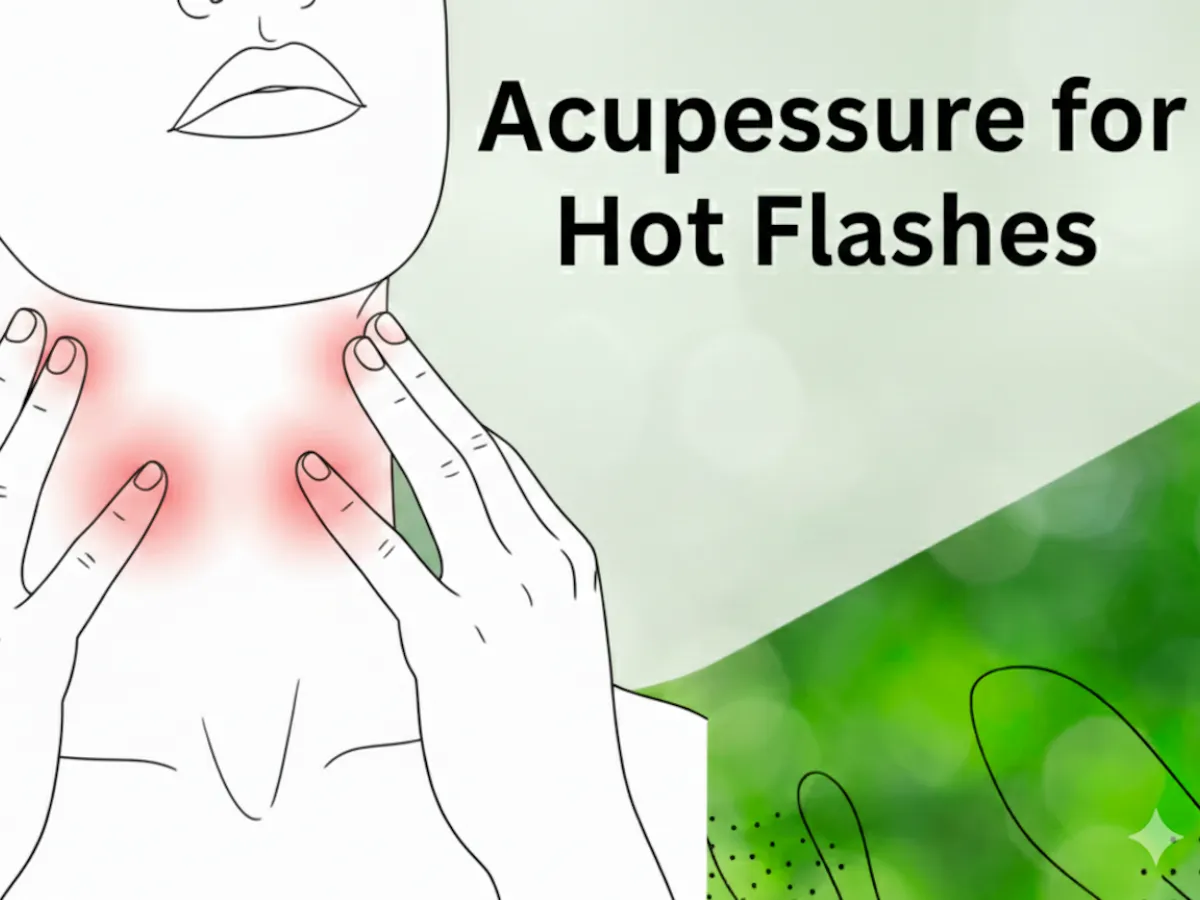
A hot flash is a sudden warm feeling in the face, neck and chest. When it happens at night and causes sweating, it is called a night sweat. Hot flashes belong to the menopausal transition (perimenopause), the years before periods stop for good. Menopause itself most often comes between ages 45 and 55.
MedlinePlus notes two things that shape how to think about them:
- they are usually worst in the first 1 to 2 years, and menopause symptoms may last 5 years or more;
- alcohol, spicy food and caffeine can make them worse, and so can being overweight.
So this is something to manage over months or years, not a single episode. Acupressure is one self-care habit for that. The Hot Flashes page is the reference; this post explains the routine and the evidence behind it.
What research says
A 2013 Cochrane review pooled 16 randomised trials with 1,155 women. It looked at needle acupuncture, not acupressure. Most trials were small and short.
- Against sham (fake) acupuncture, there was no difference in how often hot flashes came. They were somewhat less severe with acupuncture, but the effect was small and the evidence very low quality.
- Against no treatment, acupuncture appeared to help.
- Against hormone therapy, acupuncture appeared less effective.
The authors found insufficient evidence to say whether acupuncture works for hot flashes, and advise that the findings be treated with great caution because the evidence was low or very low quality. Data on side effects were lacking.
The review did not cover acupressure, so the points below are tradition, labelled as such. The routine pairs them with slow breathing, which MedlinePlus recommends on its own.
The points
Traditional use: in TCM, these points are traditionally used for hot flashes and night sweats. Each point's page shows where to find it and when to skip it.
- Main points: KI-3 Supreme Stream (Tài xī) at the inner ankle, SP-6 Three Yin Intersection (Sān yīn jiāo) on the lower leg, and GV-20 Hundred Meetings (Bǎi huì) on the top of the head.
- Optional: HT-7 Spirit Gate (Shén mén) on the wrist.
- When the heart races with a hot flash: PC-6 Inner Pass (Nèi guān) on the inner forearm.
- Other points the page lists: CV-4 Gate of Origin (Guān yuán) on the lower belly and BL-23 Kidney Shu (Shèn shū) on the back.
How to press
The Hot Flash routine has the order and timings. It works in two ways: at the first sign of heat rising, or as a daily practice.
- Find a cool, quiet place and loosen tight clothing. Take off a layer if you can.
- Breathe slowly before you press anything. MedlinePlus suggests slow, deep breathing as soon as a hot flash begins, about 6 breaths a minute. The routine's count, in through the nose for 4 and out through pursed lips for 6 to 8, gives roughly that pace.
- Keep breathing that way while you press. Use your thumb or fingertip, straight into the skin, with firm, steady pressure you can clearly feel but that never hurts. Start lighter until you know how much feels right.
- Hold each point for 15 to 30 seconds to begin with, and work up to 1 to 2 minutes. Do both sides for KI-3, SP-6, HT-7 and PC-6. On GV-20, use light, slow circles.
Don't press on broken, irritated or blistered skin, bruises or new scars. If you have a bleeding or clotting disorder or low platelets, press more lightly and for less time, or ask your doctor first.
If you might be pregnant, leave out SP-6 and CV-4: the guide marks them as traditionally avoided in pregnancy (see their pages).
Alongside the points
MedlinePlus lists these for hot flashes:
- Dress lightly and in layers you can take off when a hot flash starts.
- Avoid alcohol, spicy food and caffeine.
- Get plenty of exercise.
- Try yoga, tai chi or meditation.
Medicines and hormone therapy (usually estrogen, or estrogen plus a progestin) both have benefits and risks. Talk with your provider about whether either is right and safe for you.
When to see a provider
Contact your provider if:
- lifestyle changes are not enough to improve your symptoms
- you are spotting blood between periods
- you have gone 12 months in a row without a period, and vaginal bleeding or spotting starts again
Periods can become irregular in perimenopause. Bleeding after 12 months without a period is different, and is on the list above.
See also when not to self-treat.