Which headache is it?
The points differ with the kind of headache, so it helps to know which one you have. MedlinePlus describes the two most common:
- Tension headache, the most common type: dull and pressure-like rather than throbbing, like a tight band around the head, often worse in the scalp, temples or the back of the neck. It comes from tense neck and scalp muscles, for example after holding your head in one position for a long time. See Headache - Tension.
- Migraine: throbbing pain, usually on one side, often with nausea, vomiting, or sensitivity to light and sound. Some people first have an aura, most often in their vision: blind spots, zigzag lines or flashing lights. See Migraine.
There are other kinds: cluster headaches, sinus headaches, headaches with a cold, flu or fever, and rebound headaches from taking pain medicine more than 3 days a week. For a headache you can't place, start with the general Headache page.
What research says
The research is on acupuncture by a practitioner, not on pressing points yourself. Two Cochrane reviews from 2016 looked at a course of at least six acupuncture sessions:
- Tension-type headache: headache days were at least halved in 48 of 100 people who had acupuncture, against 17 of 100 on usual care alone. Against sham (fake) acupuncture the gap was smaller: 52 against 43 of 100. The reviewers rated the evidence as moderate quality and concluded that acupuncture is effective for frequent episodic or chronic tension-type headache.
- Migraine: adding acupuncture to the usual treatment of attacks reduced how often migraines happened. The effect over sham acupuncture was small, and acupuncture may be at least as effective as preventive drugs, with fewer side effects than the drugs. Here too the evidence was moderate quality, and studies longer than a year are lacking.
Neither review studied acupressure, and we have not found a review of self-applied acupressure for headache to cite. What follows is tradition, labelled as such.
The points
Traditional use: in TCM, these points are traditionally used for headache. Each point's page shows where to find it.
- Any headache: GB-20 Wind Pool (Fēng chí), GV-20 Hundred Meetings (Bǎi huì) and LI-4 Joining Valley (Hé gǔ).
- Tension headache: LI-4, LR-3 Great Rushing (Tài chōng) and EXT-2 Hall of Impression (Yìn táng).
- Migraine: GB-20, TE-5 Outer Pass (Wài guān) and LR-2 Moving Between (Xíng jiān).
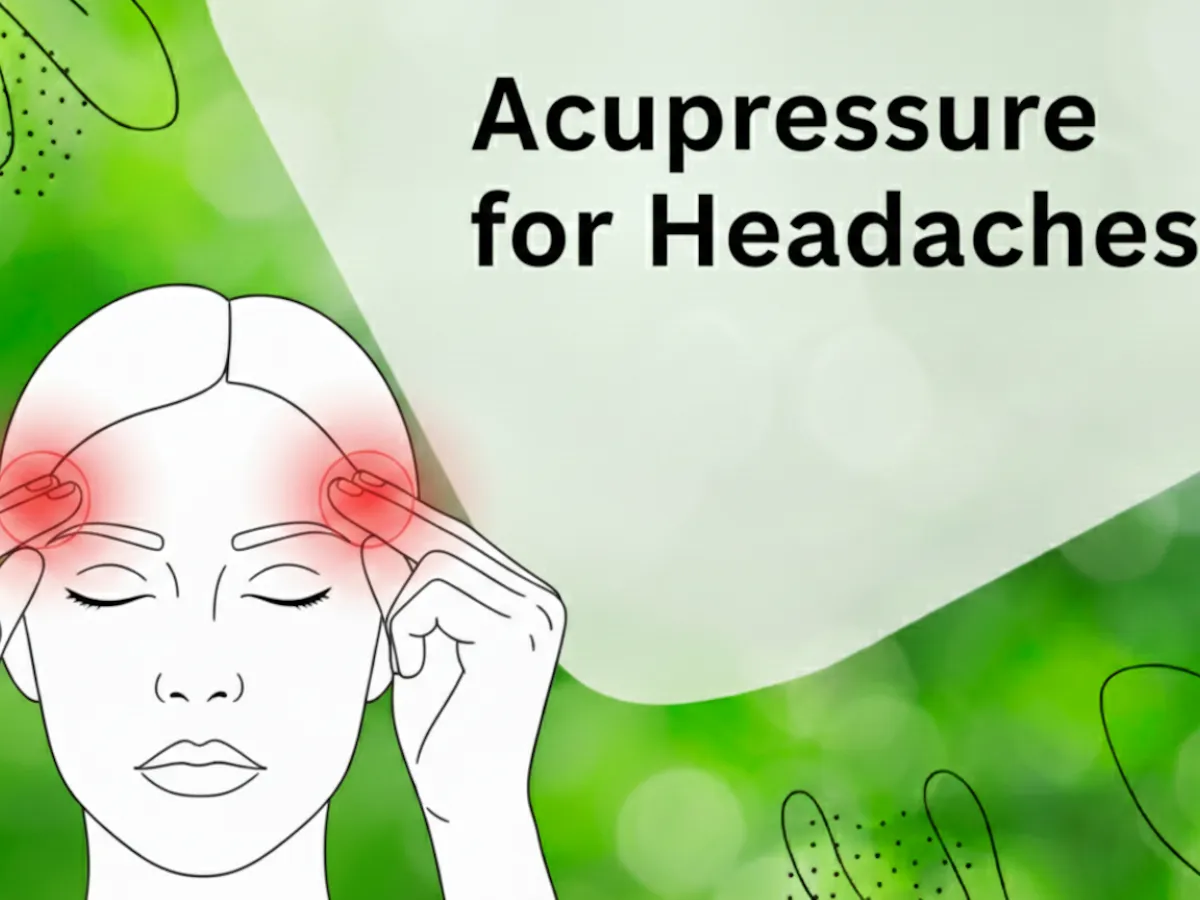
- Pain at the temples: EXT-5 Supreme Yang (Tài yáng) or ST-8 Head's Binding (Tóu wéi).
Each concern page has its own routine with the timings.
How to press
For a migraine, lie down in a quiet, dark room with a cool cloth on your head. For a tension headache, sit somewhere quiet with your neck and shoulders relaxed.
- Press with your thumb or fingertip, straight into the skin. The pressure should be firm, steady and noticeable, but never painful. Start lighter until you know how much feels right.
- Hold each point for 15 to 30 seconds to begin with. You can work up to 1 to 2 minutes.
- Do both sides for points that come in pairs.
- Go gently on the head and neck points: no deep, unrelenting pressure.
Don't press on broken, irritated or blistered skin, bruises, burns or new scars. Leave out the head and neck points after a head or neck injury. If you have a bleeding or clotting disorder or low platelets, press more lightly and for less time, or ask your doctor first.
In pregnancy, leave out LI-4: the guide marks it as traditionally avoided in pregnancy (see its page).
Keep a headache diary
MedlinePlus suggests writing down when each headache starts, what you ate and drank, how you slept, what you were doing and how long it lasted. Over a few weeks the diary can show your triggers, and it is worth taking to your provider.
Common migraine triggers include stress and anxiety, missed meals, poor or changed sleep, alcohol, caffeine withdrawal, hormone changes, bright light, loud noise and strong smells. Tension headaches are often linked to stress, tiredness, eye strain, a poor sleeping position, jaw clenching and holding the head in one position for a long time.
When a headache needs help
Call your local emergency number for a headache that comes on suddenly and is explosive, the worst headache of your life, or a headache with slurred speech, a change in vision, weakness or trouble moving your arms or legs, loss of balance, or confusion. Do not stop to try acupressure first.
Contact a health care provider if:
- the headache gets worse over 24 hours, or comes after a head injury
- it comes with fever, a stiff neck, or nausea and vomiting
- you are older than 50 and have only recently started getting headaches
- it is severe and in one eye with redness, or comes with vision problems, jaw pain when chewing, or weight loss
- your headache pattern changes, or treatments that used to work no longer help
- you need pain medicine more than 3 days a week
- you have a history of cancer and develop a new headache
See also when not to self-treat.