What a panic attack is
MedlinePlus describes a panic attack as a sudden episode of intense fear that something bad will happen. It starts without warning and usually peaks within 10 to 20 minutes, though some symptoms can last an hour or more. During an attack a person usually has at least four of these:
- chest pain or discomfort, palpitations or a pounding heart;
- shortness of breath, a smothering feeling or a feeling of choking;
- dizziness or feeling faint, nausea, numbness or tingling;
- sweating, chills or hot flashes, trembling or shaking;
- a sense that things are unreal or that you are detached from yourself;
- fear of dying, of losing control, or of something terrible about to happen.
Repeated attacks are part of panic disorder, a type of anxiety disorder. It is twice as common in women and usually begins in the late teens or early adulthood. Its cause is unknown. Early on, attacks often come with no trigger, and remembering a past attack can set off a new one.
The Panic Attack page is the reference; this post is about the minutes of an attack itself. For worry that lasts day to day, see Anxiety.
The heart comes first
MedlinePlus warns that a panic attack may be mistaken for a heart attack, and the two share signs. The CDC lists the main heart attack signs as chest pain or discomfort; feeling weak, light-headed or faint; pain or discomfort in the jaw, neck or back, or in one or both arms or shoulders; and shortness of breath. Women are more likely to also have unusual tiredness, or nausea and vomiting.
If you have chest pain and are not sure it is panic, call your local emergency number right away. Don't stop to try acupressure first. The same goes for someone else's chest pain. This matters most for a first attack: many people with panic disorder first go to an emergency room, and a provider has to rule out other medical causes before panic disorder can be named.
Thoughts of suicide: call your local emergency number. In the United States, you can also call or text 988, the Suicide & Crisis Lifeline, at any hour. If someone has attempted suicide, call for emergency help right away and don't leave them alone.
See a provider if panic attacks interfere with your work, your relationships or your self-esteem. See also when not to self-treat.
What research says
We found no Cochrane review of acupressure or acupuncture for panic attacks or panic disorder, so little high-quality research exists. MedlinePlus says talk therapy and medicines combined work best for panic disorder, and that most people improve with proper care. So the points below are tradition, labelled as such: something to do with your hands and breath while an attack passes, alongside care, not in place of it.
The points
Traditional use: in TCM, points such as PC-6, HT-7 and EXT-2 are traditionally used for panic and agitation. Each point's page shows where to find it and when to skip it.
- Main points: PC-6 Inner Pass (Nèi guān) on the inner forearm, HT-7 Spirit Gate (Shén mén) at the wrist crease, and EXT-2 Hall of Impression (Yìn táng) between the eyebrows.
- For chest tightness, once you know it is panic: CV-17 Middle of the Chest (Shān zhōng) on the breastbone.
- Optional, on the feet: KI-1 Gushing Spring (Yǒng quán) on the sole, or LR-3 Great Rushing (Tài chōng) on the top of the foot.
How to press
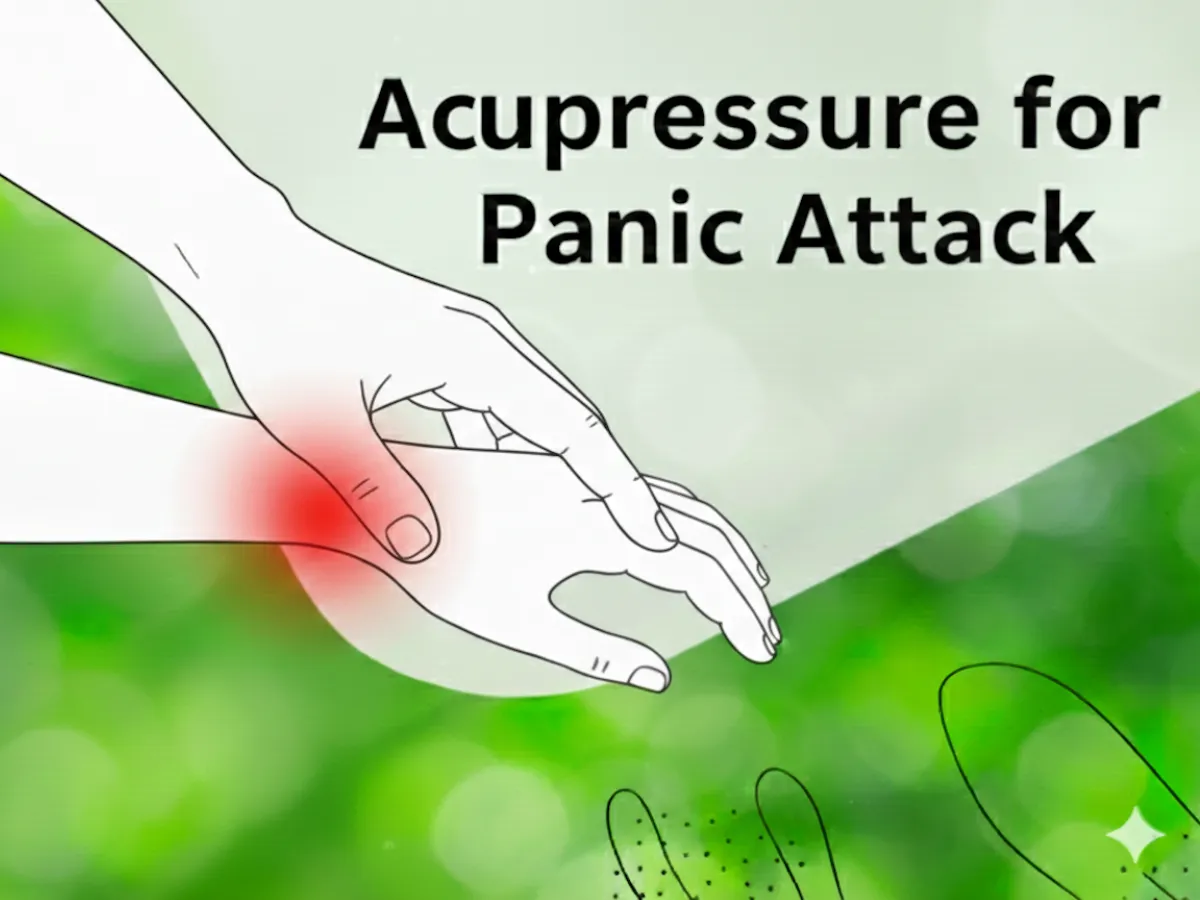
The Panic Attack routine takes 5 to 10 minutes, about the time an attack takes to peak. The idea behind it: an attack can't be predicted, but it peaks and passes, so the routine gives you something simple to do while it runs its course. You sit or lie down so a dizzy spell can't make you fall, breathe out longer than you breathe in, and keep your attention on steady pressure at the wrists. Every point is one you can reach yourself, or a helper can hold for you.
- Sit or lie down somewhere safe, and breathe slowly: in for 4 counts, out for 6.
- Press PC-6 on one arm, then the other, firm but never painful.
- Press HT-7 lightly at the little-finger end of the wrist crease, gentle and steady.
- Rest a fingertip on EXT-2 and massage it lightly, letting the brow soften.
- For chest tightness, only once you know it is panic and not the heart: press CV-17 gently on the breastbone.
- Optional: press KI-1 on the sole or LR-3 on the top of the foot.
Hold each point for 15 to 30 seconds to start, working up to 1 to 2 minutes as you get used to it, and keep breathing out slowly the whole time. Pressure should never be painful.
Skip or ease off: CV-17 with any chest pain, after recent chest surgery, or with a serious heart condition unless your doctor has said it is fine. HT-7 is kept gentle; its page notes it can stir up strong feelings. PC-6 after a wrist injury or surgery, and ease off if your fingers tingle. EXT-2 with a nosebleed, a broken nose or an injury to the face. LR-3 after foot surgery or if you have very low blood pressure. KI-1 over an open wound or infection on the sole. Don't press on broken, irritated or blistered skin, bruises or new scars. If you have a bleeding or clotting disorder or low platelets, press more lightly and for less time, or ask your doctor first.
Between attacks
MedlinePlus lists these self-care steps for panic disorder:
- don't drink alcohol;
- eat at regular times;
- get regular exercise and enough sleep;
- reduce or avoid caffeine, certain cold medicines and other stimulants, which can trigger attacks or make them worse.
Talk therapy teaches you to understand attacks as they happen, replace the thoughts that drive them, and slowly face the situations you have started to avoid. Medicines for panic disorder are taken every day; don't stop them without talking to your provider. A support group can help with feeling alone, but it is usually not a substitute for therapy or medicine. The Anxiety routine is a longer, daily calming practice for the time between attacks.