Knee pain has many causes
MedlinePlus lists two kinds of cause. Some are conditions: arthritis, a Baker cyst behind the knee, infections, and cancers that begin in or spread to the bones. Others are injuries and overuse: bursitis, tendinitis, a dislocated kneecap, iliotibial band syndrome, torn ligaments or cartilage, fractures, and sprains and strains. Being overweight raises the risk.
Simple causes often clear up on their own with home care. Pain after an injury, or with any of the signs below, needs a provider first, not points.
The Knee Pain page is the reference; this post explains the routine and the evidence behind it.
What research says
We found no Cochrane review of acupressure for knee pain. The closest is a 2010 Cochrane review of needle acupuncture for osteoarthritis of the knee, hip or hand. It pooled 16 studies with 3,498 people; 12 of them were of knee osteoarthritis only.
- Against sham acupuncture: pain and function were a little better after about 8 weeks, but the difference was small, below what the authors counted as clinically relevant, and probably due at least partly to placebo effects. At 6 months the difference was borderline and not clinically relevant.
- Against a waiting list: the gains were larger, and the authors judged that much of them may come from expectation or placebo.
- Against exercise: acupuncture did about as well as home exercise or supervised exercise, and adding it to an exercise program added nothing.
So the research is about needles, about osteoarthritis, and about small effects; its searches stop at the end of 2007. It does not show what pressing points at home does for a sore knee. The points below are tradition, labelled as such.
The points
Traditional use: in TCM, points such as ST-35, GB-34 and SP-9 are traditionally used for knee pain and stiffness. Each point's page shows where to find it and when to skip it.
- Main points: ST-35 Calf's Nose (Dú bì) at the front of the knee, GB-34 Yang Mound Spring (Yáng líng quán) below the outer side of the knee, and SP-9 Yin Mound Spring (Yīn líng quán) below the inner side.
- For pain at the back of the knee: BL-40 Middle of the Crook (Wěi zhōng).
- For knee trouble that keeps coming back: the EXT-39 Knee Eyes (Xī yǎn).
- Also used: KI-10 Yin Valley (Yīn gǔ), at the inner end of the crease behind the knee.
How to press
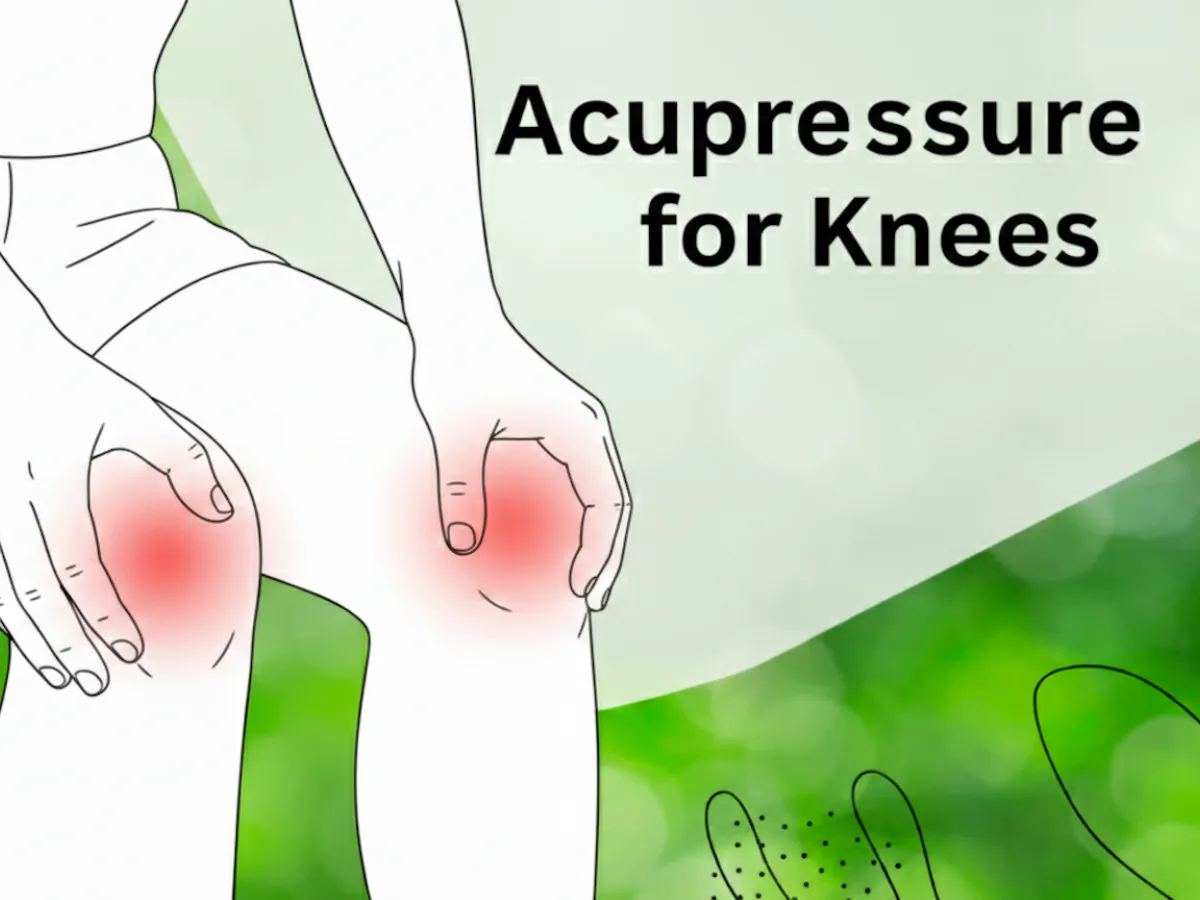
The Knee routine has the order. The idea behind it: the points at the joint (ST-35, the Knee Eyes, BL-40 and KI-10) sit over a knee that may be sore or swollen, so they are touched gently, or massaged in small circles, never pressed hard. The points just below the joint (GB-34 and SP-9) sit away from it and take steady, firmer pressure, still never painful.
- Sit with the knee supported and the leg relaxed, with a pillow under it if needed.
- Massage ST-35 gently in small circles, the knee slightly bent.
- Press GB-34 steadily for 1 minute.
- Press SP-9, firm but never painful.
- For pain at the back of the knee, massage BL-40 lightly with the knee slightly bent: large blood vessels run there, so never press deeply.
- For knee trouble that keeps coming back, add the Knee Eyes, pressed gently with thumb and finger.
Do one knee for 5 to 10 minutes. Hold each point for 15 to 30 seconds to begin with, and work up to 1 to 2 minutes.
Skip: the knee points after recent knee surgery, with a serious or fresh knee injury, or with a knee infection; stop if swelling or pain increases. GB-34 during an acute leg cramp; stop if spasms get worse. SP-9 with serious kidney disease unless your doctor agrees. BL-40 with a bleeding disorder. Don't press on broken, irritated or blistered skin, bruises or new scars. If you have a bleeding or clotting disorder or low platelets, press more lightly and for less time, or ask your doctor first.
Home care alongside
For mild knee pain that has just started, MedlinePlus suggests:
- resting and avoiding the activities that cause the pain, and keeping weight off the knee;
- ice, and keeping the knee raised;
- an elastic bandage for support.
To lower the chance of knee pain: warm up before exercise and cool down after, stretch the muscles at the front and back of the thigh, cycle or, better, swim instead of running, wear well-cushioned shoes that fit, and lose weight if you are overweight.
When to contact a provider
MedlinePlus says to contact your provider if:
- you cannot bear weight on the knee;
- you have severe pain, even when not bearing weight;
- your knee buckles, clicks or locks;
- your knee is deformed or misshapen;
- you cannot bend or straighten the knee;
- you have a fever, or redness, warmth or a lot of swelling around the knee;
- you have pain, swelling, numbness, tingling or a bluish color in the calf below the sore knee;
- you still have pain after 3 days of home care.
Pain that starts with an injury goes to a provider first. Acupressure is not a reason to wait. See also when not to self-treat.