
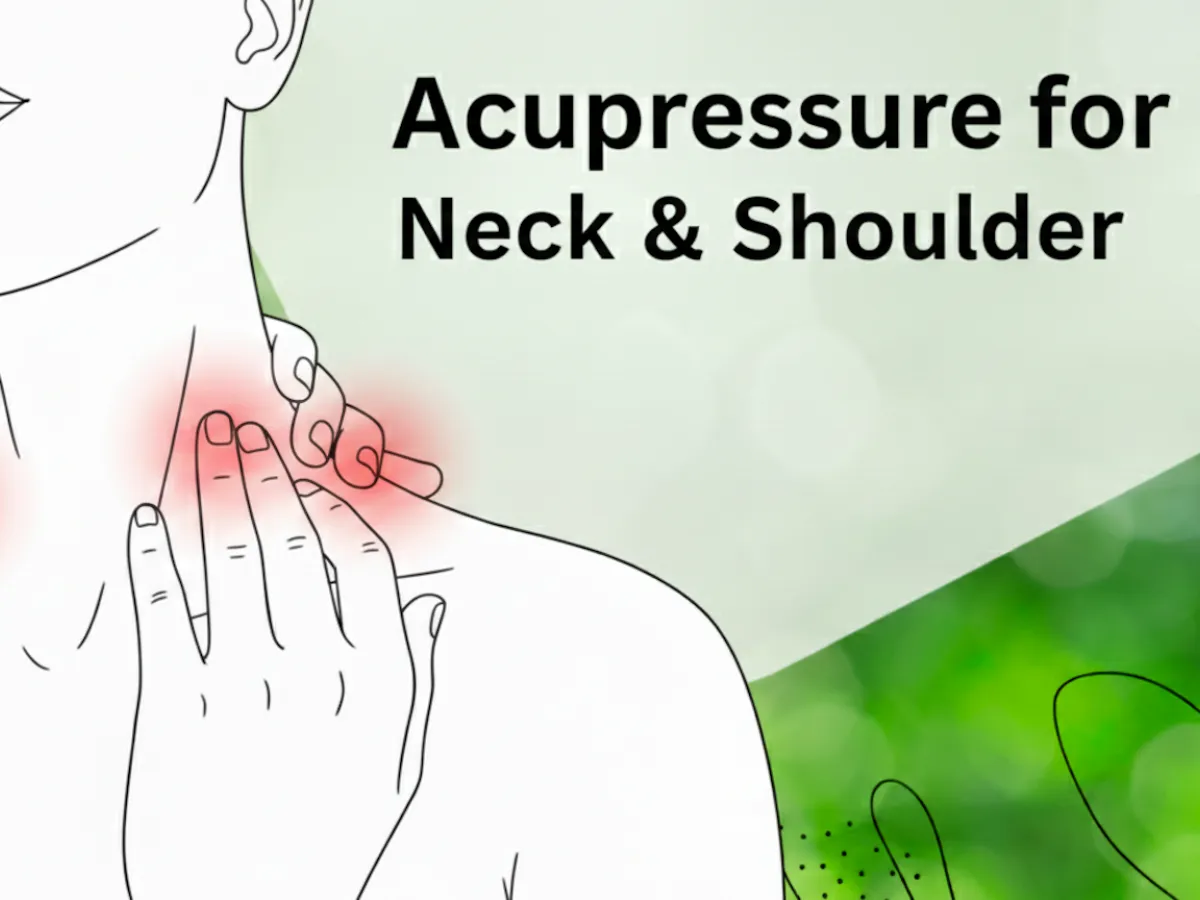
Most neck pain comes from strain
Neck pain can come from any of the structures in the neck: muscles, nerves, bones, joints or the discs between the bones. MedlinePlus names muscle strain or tension as the most common cause, usually from everyday habits: long periods bent over a desk, poor posture while reading or watching TV, a screen set too high or too low, sleeping in an awkward position, or a jerky movement while exercising.
That is where acupressure fits: as self-care for a stiff neck and tight shoulders, alongside the home care below. It does not replace a check-up when the pain has another cause.
The Neck/Shoulder Pain page is the reference; this post explains the routine and the evidence behind it.
When neck pain is an emergency
Call your local emergency number if you have:
- a fever and headache with a neck so stiff you cannot touch your chin to your chest;
- neck pain with signs of a heart attack, such as shortness of breath, sweating, nausea, vomiting, or arm or jaw pain;
- neck pain after a fall, a blow or an injury, and you cannot move your arm or hand.
Do not press points first.
What research says
We found no current Cochrane review of acupressure, or of acupuncture, for neck pain.
So for neck pain, little high-quality research exists, and the points below are tradition, labelled as such.
The points
Traditional use: in TCM, points such as BL-10, SI-3 and LU-7 are traditionally used for neck and shoulder pain and stiffness. Each point's page shows where to find it and when to skip it.
- Main points: BL-10 Celestial Pillar (Tiān zhù) at the back of the neck, SI-3 Back Stream (Hòu xī) on the edge of the hand, and LU-7 Broken Sequence (Liè quē) on the forearm.
- For tight shoulders: GB-21 Shoulder Well (Jiān jǐng) on top of the shoulder, or SI-15 Middle Shoulder Shu (Jiān zhōng shū) beside the base of the neck.
- Also used: GB-20 Wind Pool (Fēng chí) below the base of the skull, and LI-4 Joining Valley (Hé gǔ) on the back of the hand, for general tension.
SI-3, LU-7 and LI-4 are on the hand and forearm, so you can press them when the neck is too stiff or sore to touch.
How to press
The Neck and Shoulder routine has the order and timings. Two ideas sit behind it. Settle the posture first, because posture is often part of the cause. And the points on the neck sit close to the spine and the base of the skull, so they get gentle fingertip pressure, never force; the firm pressure goes on the hand.
- Sit upright and gently roll your shoulders back.
- Rest your fingertips on BL-10 on both sides and press gently. Never press hard or rock the neck here.
- Press SI-3 firmly with the other thumb for 1 minute on each hand.
- Press LU-7 gently on each forearm.
- For tight shoulders, squeeze GB-21 with the opposite hand, with moderate pressure.
- For general tension, add LI-4: firm, steady and noticeable, but never painful.
If you use GB-20, press upward toward the skull, not into the neck, and stop if you feel dizzy. Hold each point for 15 to 30 seconds to begin with, and work up to 1 to 2 minutes. Do both sides for points that come in pairs.
Skip: LU-7, GB-21 and LI-4 during pregnancy; BL-10, GB-20, GB-21, SI-15 and SI-3 after a neck injury; BL-10 and GB-20 with known instability in the neck; GB-20 with very high blood pressure. With a seizure disorder, ask your doctor before using SI-3. Don't press on broken, irritated or blistered skin, bruises or new scars. If you have a bleeding or clotting disorder or low platelets, press more lightly and for less time, or ask your doctor first.
Home care alongside
MedlinePlus suggests, for the common, minor causes:
- ice for the first 48 to 72 hours, then heat, and never falling asleep on a heating pad or ice pack;
- stopping normal physical activity for the first few days, then slow range-of-motion exercises: up and down, side to side, and ear to ear;
- a firm mattress and a pillow that supports your neck.
Since screen height and posture are common causes, check where your screen sits and how you hold your head while reading.
When to contact a provider
MedlinePlus says to contact your provider if:
- symptoms do not go away in 1 week with self-care;
- you have numbness, tingling or weakness in your arm or hand;
- you have swollen glands or a lump in your neck;
- you have trouble swallowing or breathing with the pain;
- the pain gets worse when you lie down or wakes you at night;
- the pain is so severe that you cannot get comfortable;
- you lose control over urination or bowel movements;
- you have trouble walking and balancing.
Acupressure is not a reason to wait. See also when not to self-treat.